
2026-10-05 · Dr Saqlain
Feline Calicivirus Treatment and Cure: What Really Helps
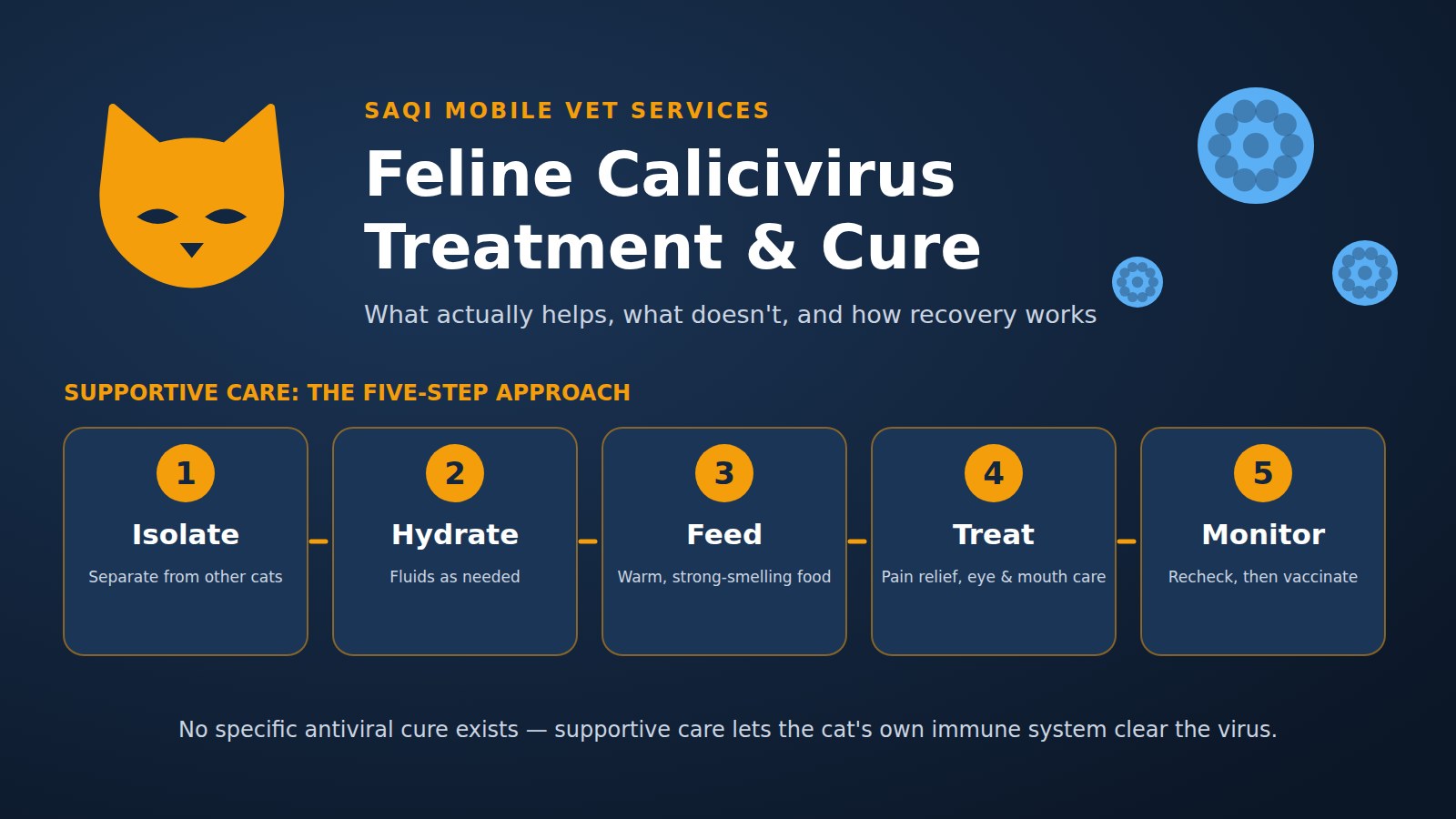
If your cat has mouth ulcers, a runny nose and will not eat, the first question is usually: is there a cure for feline calicivirus? The honest answer is that there is no approved drug that cures the virus. Most cats recover because good supportive care keeps them hydrated, fed and comfortable while their own immune system clears the infection. Getting that care right, and early, is what treatment really means for calicivirus.
Is There a Cure for Feline Calicivirus?
There is no specific antiviral that has been proven to cure calicivirus in cats. Treatment is supportive: the vet treats the symptoms and complications so the cat can get through the illness. Most healthy adult cats with mild calicivirus improve over one to three weeks. Kittens, older cats and cats with other illnesses are more vulnerable, and the rare virulent systemic form can be life-threatening even with intensive care.
It is also important to know that a cat that has "recovered" can sometimes keep carrying and shedding the virus. Some carriers stay well, while others have flare-ups during stress or have long-term gum inflammation (stomatitis). Recovery usually means the cat is well again, not that the virus has always gone.
What Treatment Actually Involves
A vet will look at how sick the cat is and build a plan around these steps:
- ✓Hydration. Cats that are not eating or drinking enough need fluids, given under the skin or by drip if they are more unwell.
- ✓Nutrition. Warm, strong-smelling, soft food encourages a cat with a blocked nose and sore mouth to eat. Some cats need appetite support or syringe or tube feeding.
- ✓Pain relief. Mouth ulcers hurt. Cat-safe pain relief prescribed by a vet often makes the difference between a cat that eats and one that does not.
- ✓Antibiotics when needed. Antibiotics do not work on viruses, but they are used when a secondary bacterial infection is present, such as thick yellow or green discharge or pneumonia.
- ✓Eye, nose and mouth care. Gently wiping discharge with warm damp cotton, steamy bathroom sessions, and medicated eye drops where indicated.
- ✓Monitoring. Weight, temperature, hydration and breathing are rechecked, because a cat that stops eating can decline quickly.
What Not to Do
- ✓Never give human medicines. Paracetamol (acetaminophen) and ibuprofen are toxic to cats and can be fatal.
- ✓Do not use leftover antibiotics. They will not treat the virus and can cause harm or resistance.
- ✓Do not wait for a cat to stop eating for days. Cats that go without food can develop serious liver problems, so call a vet if your cat has not eaten for a day.
- ✓Do not assume it is only a cold. Breathing difficulty, swollen face or paws, jaundice or crusted ulcers on the nose or paws need urgent care.
Home Care While Your Cat Recovers
Once a vet has examined the cat, home nursing is a big part of recovery.
- ✓Keep the cat in a warm, quiet, draught-free room, separate from other cats.
- ✓Offer small, frequent meals of smelly, soft food, slightly warmed. Always keep fresh water available.
- ✓Clean the eyes and nose gently several times a day.
- ✓Use separate bowls, bedding and litter, and wash your hands and change clothes after handling the cat.
- ✓Give prescribed medicines exactly as directed, and note how much the cat eats and drinks each day.
How Long Does Recovery Take?
Mild cases often improve within a week and are largely over in two to three weeks, although the appetite and mouth sores can take longer to settle. Cats with pneumonia or the virulent systemic form need much more intensive care and a longer recovery. Even after the cat looks well, keep it away from other cats for a while, because it may still shed virus.
Cleaning Your Home After Calicivirus
Calicivirus is tough. It can survive on surfaces for up to about a month and is not reliably killed by many common household cleaners. Clean away dirt first, then disinfect with household bleach diluted at about 1 part bleach to 32 parts water, or a veterinary virucidal disinfectant such as potassium peroxymonosulfate, leaving it on the surface for the contact time on the label. Rinse food bowls well afterwards, ventilate the room, and keep your cat out of the room until surfaces are dry, as bleach fumes can irritate a cat's airways. Wash bedding on a hot cycle.
Prevention: Vaccination Is the Best Protection
The core cat vaccine (FVRCP) protects against calicivirus, herpesvirus and feline panleukopenia (FPV). It does not guarantee a cat will never catch calicivirus, because the virus has many strains, but it greatly reduces how sick a cat becomes. Kittens need a series of boosters, then regular boosters as advised by your vet. Read more on our Feline Calicivirus & FPV service page, which covers symptoms and how both viruses spread.
When to Call a Mobile Vet in Lahore
Call as soon as you notice mouth ulcers, drooling, a cat that has stopped eating, a kitten with a cough, or any swelling of the face or paws. Saqi Mobile Vet Services can examine your cat at home, start fluids and medication, and guide nursing and disinfection. Mon–Wed we are available 4pm–1am, and Fri, Sat and Sun 24/7. Call 03487915745, or see our cat flu service and emergency care pages.